useiManage Strategy and User Research
From Strategy to Launch
This research became the foundation for the free tier and Pathways structure now live on useiManage. → See useiManage Today
This project contributed to my being honored with the 2025 iManage “Is There a Better Way” Employee Award for innovation
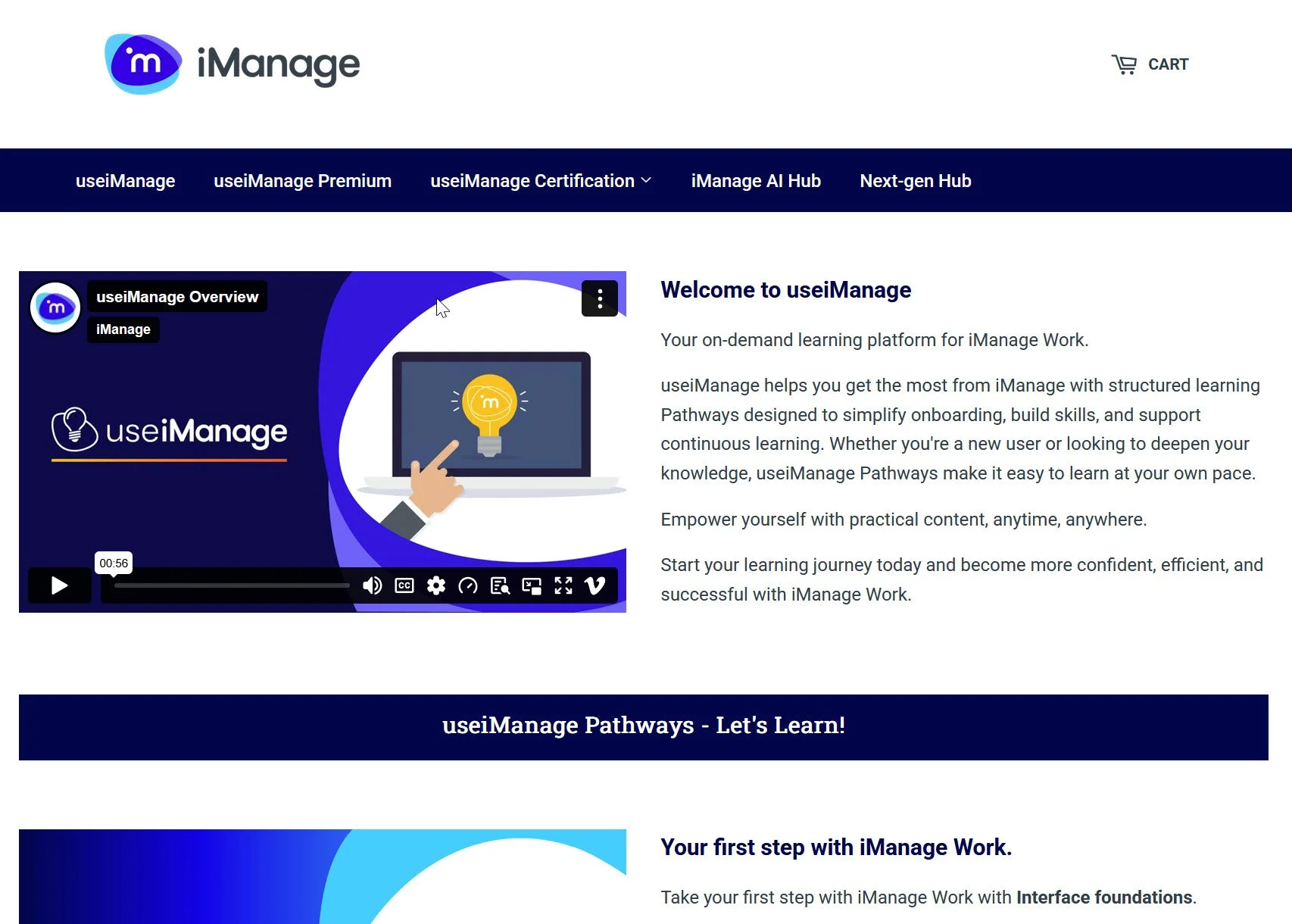
From a Portal to a Platform
iManage's existing eLearning subscription program was strong, but access depended entirely on a customer's contract.
Our docs page was built for a technical audience rather than a general end user.
My team already understood learner needs deeply and had the technical expertise to produce timely content on a public-facing site to extend our learning offerings.
useiManage pathways grew out of that gap: a free, public tier of end-user education, built as an extension of a resource customers already trusted rather than something new.
The project also supported the broader shift to iManage's Success Plan model to give every customer, regardless of subscription level, access to the learning tools they need.
Understanding Our Users: Proto-Personas
I led a proto-persona workshop with the team, applying user research methods from the information architecture coursework in my MLIS program at San Jose State University.
We used affinity mapping to cluster real user feedback into attributes and needs, then built proto-personas from those clusters, distinguishing a legal version and a corporate version of each.
Every persona carried a Learner Goal, structured the same way as a learning objective, so content decisions later in the process had a clear target to serve.
Card Sorting and Content Architecture
To decide how content should be grouped into learning paths, I ran a card sorting exercise built from real tasks in useiManage, spanning Work Web, Desktop for Windows, and Search.
This is classic information architecture methodology, applied here to a live content library instead of a theoretical data set, and it gave us an evidence-based structure for bundling topics rather than one based on internal assumptions about what belonged together.
Competitive Assessment
I evaluated seven learning platforms across the industry, including Asana Academy, Shopify Academy, Workday, and Learn Dropbox as strong non-legal examples, and Clio Academy, Litera University, and Intapp University as legal-industry comparisons.
I assessed each on content depth, homepage design, pricing model, and login friction.
The pattern that stood out most was how much friction competitors built into their entry points: some required account creation before a user could see anything, and one required manual approval that took up to a business day.
That finding shaped our own approach to minimizing barriers between a customer and the content they needed.
From Sitemap to Service Blueprint
I mapped the existing site structure against a proposed one and built a full service blueprint covering every system involved.
Scoping the MVP meant choosing a small, well-executed set of content over a broader library, prioritizing focused execution over surface-level coverage.
Learning Journey Mapping
I mapped the full learner journey across six phases, from first noticing useiManage Academy through sustaining use over time, and tied each phase to real touchpoints: the iHelp link, marketing emails, and a PowerBI dashboard that tracks follow-up. This gave the team a shared model of not just what content to build, but when and where a learner would actually encounter it.